Region
29.09.2023

On the territory of the Lower Castle in Polotsk, a sensational find was discovered – a unique fibula of the late X-XI centuries.
On the territory of the Spartak stadium in the Lower Castle in Polotsk, archaeologists have discovered a fragment of a Scandinavian fibula in a ceramic mold for casting.

This discovery once again confirms that in the XI century this area was home to the jewelers ' quarter.
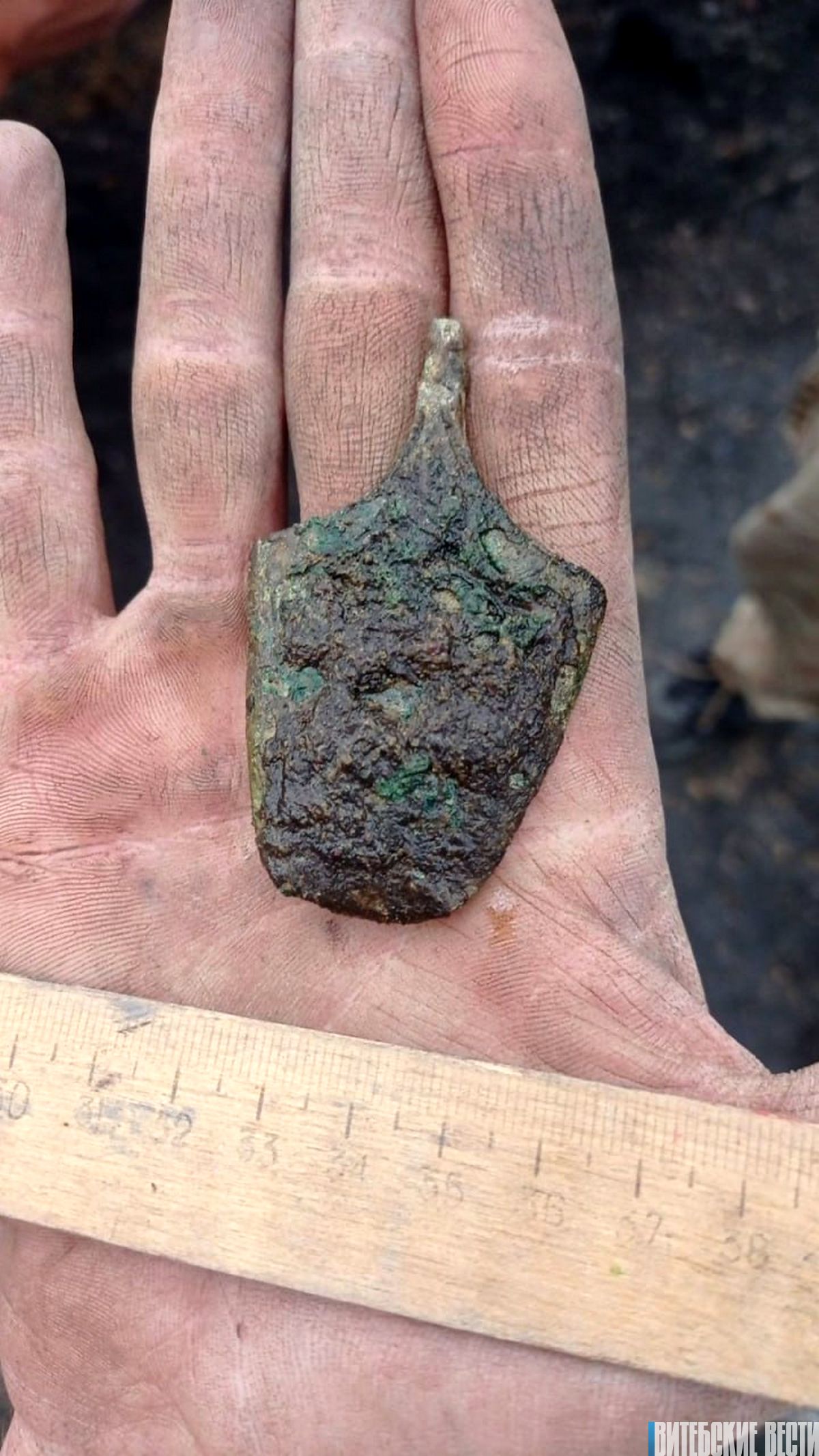
Since August of this year, excavations have been carried out here by employees of the State Institution "Institute of History of the National Academy of Sciences of Belarus" and the Educational Institution "Polotsk State University named after Euphrosyne of Polotsk", as well as students. According to Alexey Kotz, a teacher of the history of the named educational institution, during this period two clear locations of jewelry complexes for the production of jewelry of the late X - XI centuries were discovered.
- Tortoiseshell fibula (clasp for a women's sundress) is a rather rare find, it can be called super-sensational, because there were no such cases on the territory of Belarus. Such fibulas were worn by noble women, which means that in this area in ancient times there were many well-to-do people, jewelers engaged in this high-tech production. The products were originally imported from Scandinavia. But the discovery of a ceramic mold, which was discovered in Belarus for the first time, indicates that the decoration was made on our territory. Undoubtedly, jewelry was produced here. It is known that no one has previously excavated here. Such complexes were not found on the territory of Eastern Europe.

According to the archaeologist, a huge concentration of artifacts from different periods – about 1.5 thousand-was found in the stadium on 95 square meters. These findings confirm the presence of jewelry production here in the distant past: four jewelry scales for weighing metal, more than 200 beads, fragments of amber, as well as household items.
As it became known, after conducting scientific research, these exhibits will go to the funds of the museum-reserve. As a result of the expedition, the materials will be presented to a wide range of history lovers.
© SHUMILINO REGIONAL
EXECUTIVE COMMITTEE, 2026.

